
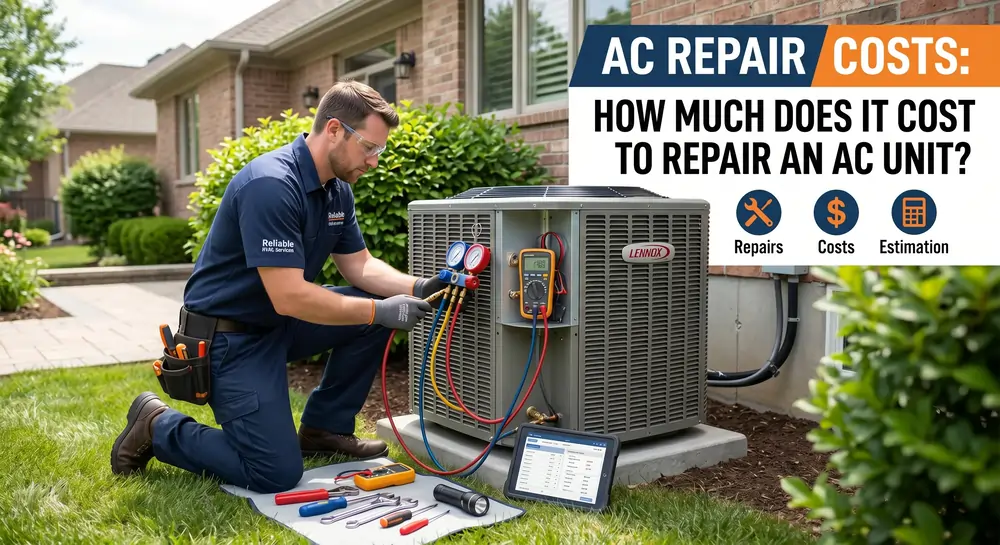
Your AC quits at 3 p.m. on a Miami afternoon. The house hits 88 degrees inside an hour. Now you have one urgent question, and it isn’t what’s wrong with the unit. It’s how much is this going to cost me?
Most homeowners pay between $150 and $650 to repair an AC unit in 2026, with the national average landing around $369. Minor fixes like a clogged drain line or a worn capacitor run $100 to $300. Major repairs involving the compressor or coil system can climb past $3,000. The exact price depends on which part failed, how old your unit is, and where you live.
This guide breaks down every common AC repair by exact dollar range, explains the rule that tells you when to repair versus replace, and shows South Florida homeowners how to avoid the inflated quotes that have made HVAC scams a regular complaint on Reddit and Quora.
How Much Does It Cost to Repair an AC Unit? (Quick Answer)
AC unit repair costs typically range from $150 to $650 for common issues, though the full range stretches from about $75 for a basic fuse replacement to over $3,000 for a compressor swap. According to Bob Vila’s industry data, the national average sits at $369. According to Angi, homeowners pay between $146 and $2,252 depending on unit type and the specific repair.
Here is the at-a-glance breakdown:
| Repair Tier | Typical Cost | Examples |
|---|---|---|
| Minor | $75 to $300 | Fuse, capacitor, thermostat, drain line |
| Mid-range | $300 to $1,000 | Refrigerant recharge, fan motor, contactor |
| Major | $1,000 to $3,500 | Compressor, evaporator coil, condenser, air handler |
Most service calls also include a diagnostic fee of $75 to $150, which some companies waive or apply toward the repair if you proceed with the work.
AC Repair Cost by Part (Detailed Price Table)
The single biggest factor in AC repair cost is which component failed, because parts and labor scale together. A capacitor swap takes 30 minutes and a $30 part. A compressor replacement takes most of a day and uses one of the most expensive components in the entire system.
Here is what each common repair costs in 2026.
Capacitor Replacement: $150 to $400
The capacitor is the small cylinder that gives the AC motor its starting jolt. When it fails, the unit either refuses to start or shuts down moments after kicking on. Capacitors are inexpensive parts, often $20 to $80, but trip charges and labor push the installed price into the $150 to $400 range. This is one of the most common AC repairs, and also one of the most commonly upsold. If a tech tells you the whole motor needs replacing for $700, ask whether the capacitor was tested first.
Thermostat Replacement: $100 to $500
A failing thermostat causes erratic cycling, wrong-temperature readings, or a system that never turns on. Basic digital thermostats cost $100 to $300 installed. Smart thermostats with humidity control and zoning, increasingly common in South Florida homes, run $200 to $500.
Refrigerant Recharge or Leak Repair: $200 to $1,500
If your AC blows warm air despite running normally, low refrigerant is a likely cause. A simple recharge runs $200 to $500. Repairing a leak first, then recharging, pushes the price toward $1,500. The refrigerant type matters enormously here. R-410A is standard and widely available. R-22, the older refrigerant phased out by the EPA, can run over $200 per pound when you can find it. If your system was installed before 2010, refrigerant work alone can cost more than the unit is worth.
Condensate Drain Line Cleaning: $80 to $250
The drain line carries condensation away from the indoor unit. When it clogs with algae or debris, water backs up and triggers the safety float switch, shutting the system down. This is one of the cheapest and most common repairs in South Florida, where humidity keeps drain lines under constant load.
Fan or Blower Motor Replacement: $300 to $800
The blower motor moves cooled air through your ducts. The condenser fan motor pushes heat out of the outdoor unit. When either fails, you’ll hear grinding noises, weak airflow, or no airflow at all. Replacement runs $300 to $800 depending on motor size, brand, and accessibility.
Evaporator or Condenser Coil Replacement: $600 to $2,000
Coils corrode, leak, and freeze. Coastal homes near Biscayne Bay and the Atlantic see faster coil corrosion because of salt air exposure. Replacing an evaporator coil runs $600 to $2,000 installed; condenser coils land in a similar range. According to Bob Vila, the average coil replacement costs around $1,300 with parts and labor combined.
Compressor Replacement: $1,000 to $3,000
The compressor is the heart of your AC system. When it fails, the unit cannot move refrigerant, and no cooling happens. CJS Heating & Air reports compressor replacement runs $1,000 to $2,800 in most cases. On larger or premium-brand systems, replacement can exceed $3,000. This is the repair that most often pushes homeowners into a replace-instead decision, especially on units more than 10 years old.
Air Handler Replacement: $1,000 to $6,000
The air handler houses the blower, evaporator coil, and electrical components. Replacing the entire unit lands anywhere from $1,000 on basic models to $6,000 for premium variable-speed systems with advanced filtration.
AC Repair Cost by System Type
Your AC system type drives repair cost because complexity dictates labor hours. A central air system has more moving parts, longer line sets, and harder access than a window unit, so even similar repairs cost more on a central setup.
Central Air Conditioner: $150 to $1,500
Central AC repair averages $150 to $1,500. The wide range reflects how many components can fail. According to This Old House, central air conditioner repairs typically run $150 to $650 for common problems like frozen coils, drain clogs, or capacitor failure. Compressor or full coil work pushes the bill to the upper end.
Ductless Mini-Split: $200 to $1,000
Mini-splits sit between central AC and window units in repair cost. The system has more electronic components than a window unit but no ductwork to contend with. Multi-zone systems with several indoor heads cost more to diagnose and repair than single-zone setups.
Window Unit: $75 to $400
Window units are the cheapest to repair because they are simple, accessible, and self-contained. Many minor repairs cost less than buying a new unit, which is why technicians often recommend replacement for window AC issues over $200.
Heat Pump: $200 to $1,600
Heat pumps run year-round, so they accumulate wear faster than cooling-only systems. Common repairs include reversing valve issues, refrigerant problems, and compressor wear. Range typically runs $200 to $1,600 per repair.
Packaged or Rooftop Unit
Packaged units house everything in one outdoor cabinet, common on Miami townhomes and small commercial buildings. Repair costs mirror central AC ranges, but rooftop access often adds $100 to $300 in labor.
What Factors Affect AC Repair Cost?
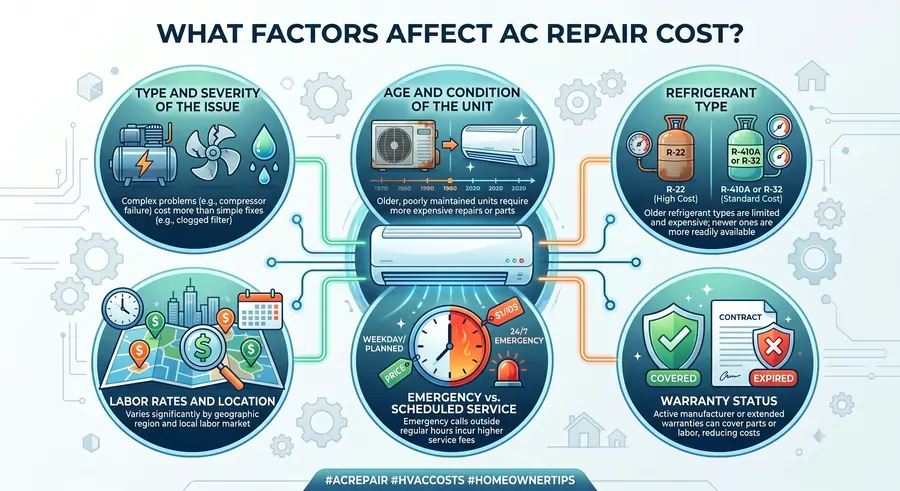
AC repair cost varies based on six measurable factors, and understanding each one helps you read a quote intelligently instead of trusting whatever number the tech writes down.
Type and Severity of the Issue
The single largest cost driver is which part failed. A clogged drain line takes 30 minutes and a wet/dry vacuum. A compressor failure takes most of a day, requires refrigerant recovery, and uses a thousand-dollar component. Always ask the technician to identify the exact failed part on the invoice, not just a generic description.
Age and Condition of the Unit
Older AC units cost more to repair. Parts for systems older than 12 years are harder to find, and worn neighboring components often fail in clusters. A 15-year-old system that needs a $400 capacitor today often needs a $1,500 fan motor next summer. According to industry data, repair frequency roughly triples after year 10.
Refrigerant Type
If your unit uses R-22, refrigerant-related repairs cost dramatically more. R-22 was phased out by the EPA starting in 2004 and is no longer manufactured in the United States. Remaining supply trades at premium prices. Newer systems use R-410A, and the latest models use R-454B, both of which are more environmentally friendly and far cheaper to source.
Labor Rates and Location
HVAC technicians charge $75 to $200 per hour, plus a service call fee of $50 to $150. Rates climb in metropolitan areas with higher costs of living. Angi’s data shows New York homeowners pay an average of $394 per HVAC repair, with an upper bound above $2,250. Miami sits in a similar tier among major U.S. metros.
Emergency vs. Scheduled Service
Emergency AC repair runs 20 to 50 percent more than standard service. After-hours, weekend, and holiday calls all carry premium rates. The same capacitor replacement that costs $250 on a Tuesday afternoon can run $400 on a Sunday night.
Warranty Status
A valid manufacturer warranty can drop your bill to labor only. Most manufacturers cover parts for 5 to 10 years on registered systems. If your unit is still under warranty, request the part number and warranty claim form from any contractor before paying retail for replacement components.
Why AC Repairs Cost More in Miami and South Florida
Miami and South Florida AC units work harder, fail faster, and cost more to repair than systems in milder climates because of three regional factors that compound on every system in the region.
Year-round usage: Most U.S. homes run AC four to six months a year. South Florida homes run AC nearly twelve months. That doubles or triples component wear, particularly on compressors, fan motors, and capacitors. A capacitor rated for 80,000 starting cycles in Ohio might log that same number in five years here.
Salt-air corrosion: Homes within a few miles of the coast see accelerated corrosion on outdoor condenser coils, fins, and copper line sets. Salt-air corrosion is a documented failure mode that ACCA-certified contractors check for during inspections, and it pushes coil replacement costs higher because corroded fasteners often need to be cut rather than unscrewed.
Hurricane-season demand spikes: From June through November, demand for AC repair surges. Power surges from storms damage capacitors and contactors. Storm debris clogs condensers. After major weather events, technician availability tightens for weeks, and emergency rates apply to nearly every call.
The practical result for Miami homeowners is that the national-average $369 figure understates what most local repairs actually cost. Plan on the upper third of every range published in national data, and budget for at least one capacitor or refrigerant service call every two to three years on systems older than five years.
Repair or Replace? The 50% and 5,000 Rules
Two industry-standard rules tell you whether a repair makes financial sense. Both are widely cited by HVAC contractors and consumer-protection sources like This Old House and Today’s Homeowner.
The 50% Rule: If the repair cost is more than 50 percent of the price of a new equivalent unit, replace instead. A $2,000 compressor repair on a system that would cost $4,500 to replace is right at the line. A $2,500 repair on the same system is over the line.
The 5,000 Rule: Multiply the age of the unit in years by the cost of the repair. If the result exceeds $5,000, replacement is the smarter financial move. A 12-year-old unit with a $500 repair scores 6,000, which signals replacement. A 6-year-old unit with the same $500 repair scores 3,000, which clearly signals repair.
When Repair Is the Smart Move
- The unit is less than 10 years old
- The repair is under 30 percent of replacement cost
- The system is under warranty
- This is the first major repair in the unit’s life
- The system uses current refrigerant (R-410A or R-454B)
When Replacement Is the Smart Move
- The unit is 12 years or older
- The repair involves the compressor or a major coil
- The system uses R-22 refrigerant
- You’ve called for repairs more than twice in 18 months
- Energy bills have climbed steadily despite normal use
The Department of Energy notes that systems installed before 2010 typically operate at SEER ratings of 10 to 13. Modern systems hit SEER 16 to 20-plus, which translates into 30 to 50 percent lower cooling bills. That savings often offsets a meaningful share of replacement cost over the life of a new unit.
How to Avoid Overpaying for AC Repair
HVAC scams are common enough that they trend on Reddit’s r/hvacadvice every summer. One Florida homeowner recently posted about a $20,000 quote for what turned out to be a basic refrigerant issue. Another reported being told a $600 repair, then handed a $1,200 invoice with surprise capacitor and coil-cleaning charges added without approval.
Here is how to protect yourself.
Get Two or Three Itemized Quotes
For any repair quoted over $500, get a second opinion. Reputable contractors will not pressure you to sign on the spot. Same-day “discount” offers that disappear if you wait are a classic high-pressure tactic.
Insist on a Written, Itemized Estimate
A legitimate AC repair estimate lists:
- The exact failed part by name and part number
- Parts cost separated from labor cost
- Labor hours and hourly rate
- Refrigerant type and amount, if applicable
- Service call or diagnostic fee
- Tax
If the contractor refuses to itemize, walk away.
Verify Technician Credentials
Trustworthy HVAC technicians hold certifications from NATE (North American Technician Excellence), ACCA (Air Conditioning Contractors of America), or SMACNA (Sheet Metal and Air Conditioning Contractors’ National Association). All three certifications are verifiable online. In Florida, also confirm the company holds an active state HVAC contractor license.
Watch for These Red Flags
- The tech recommends full system replacement on the first visit without testing individual components
- The quote jumps thousands of dollars after a brief inspection
- The contractor refuses to leave the written estimate behind
- You’re told the repair must happen “today” or the price doubles
- Add-on charges appear on the final invoice that were not disclosed beforehand
In practice, an honest tech tests the capacitor with a multimeter before recommending a motor swap, explains why each part needs replacing, and welcomes a second opinion.
Signs Your AC Needs Repair Right Away
Catching problems early keeps repair bills in the minor-fix range. Watch for these warning signs.
- Warm air from the vents: Often refrigerant-related or a failing compressor
- Weak airflow: Usually a blower motor, clogged filter, or duct issue
- Strange noises: Grinding suggests motor bearings; clicking suggests a failing capacitor or contactor; hissing suggests a refrigerant leak
- Water around the indoor unit: Almost always a clogged condensate drain line
- High humidity indoors: The system is undersized, low on refrigerant, or has an oversized cycle issue
- Energy bills climbing without changed habits: A system losing efficiency, often refrigerant or coil related
- Frequent on-off cycling: Thermostat, capacitor, or oversizing issue
- Foul or musty smells: Mold in the air handler or drain pan
A common scenario in Miami: the homeowner notices the AC running constantly without cooling well, ignores it for a week thinking it’s just a hot day, and ends up with a frozen evaporator coil that turns a $250 refrigerant top-off into a $900 coil-thaw and recharge.
How Long Does an AC Repair Take?
Repair time roughly correlates with cost. Knowing the typical timeline helps you spot inflated labor charges.
- Quick fixes (1 to 2 hours): Capacitor, fuse, thermostat, drain line clearing
- Half-day repairs (3 to 5 hours): Fan motor, contactor, refrigerant leak repair and recharge
- Full-day repairs (6 to 8 hours): Evaporator coil, condenser coil, compressor
- Multi-day repairs: Full air handler replacement, ductwork repair, line set replacement
If a contractor charges 6 hours of labor for a capacitor swap, you have grounds to question the bill.
Frequently Asked Questions About AC Repair Costs
How much does it cost to fix an AC compressor?
Compressor replacement costs $1,000 to $3,000 in 2026, with most homeowners paying between $1,500 and $2,800. The price covers the compressor itself, refrigerant recovery and recharge, labor, and disposal of the old part. On units older than 10 years, compressor failure usually triggers the 50% rule and points toward full replacement.
Is it worth repairing a 15-year-old AC unit?
Repairing a 15-year-old AC rarely makes financial sense if the repair exceeds $500. Most central air systems last 12 to 15 years, so a major repair on an aged unit just postpones replacement while energy bills climb. Run the 5,000 rule: 15 years multiplied by repair cost. Anything over $333 fails the test.
How much is a freon recharge?
A freon recharge costs $200 to $500 on systems using R-410A. On older systems still running R-22, recharge costs can exceed $1,000 because R-22 is no longer produced in the United States and trades at over $200 per pound. Always have the technician find and repair the leak first; recharging without fixing the leak just wastes money.
Why is AC repair so expensive in summer?
AC repair costs rise in summer because demand spikes when systems run hardest. Technicians charge premium hourly rates, emergency surcharges apply on nights and weekends, and parts move through suppliers faster, sometimes with markup. In Miami, summer rates typically run 15 to 30 percent above off-season pricing for the same repair.
Are AC repairs covered by home warranty?
Most home warranties cover AC repairs, but coverage limits vary by plan. Standard plans typically cover $1,500 to $3,000 per system per year. Pre-existing conditions, lack of maintenance documentation, and improper installation are common reasons claims get denied. Read your service contract carefully and keep maintenance records to support future claims.
How long does an AC unit typically last?
A well-maintained central AC unit lasts 12 to 15 years. Heat pumps last 10 to 14 years because they run year-round. Window units last 8 to 10 years. In coastal South Florida, expect the lower end of every range because of salt-air corrosion and continuous use.
The Bottom Line on AC Repair Costs
Most AC unit repairs cost between $150 and $650, with minor fixes starting around $100 and major component replacements like compressors reaching $3,000 or more. The exact bill depends on the failed part, the age of your system, the refrigerant it uses, and whether you’re calling during peak summer demand. In Miami and South Florida, plan on the upper end of every published range because of year-round use and salt-air conditions.
Before you pay for any repair quoted over $500, get an itemized written estimate, verify the technician’s NATE or ACCA credentials, and apply the 50% rule to decide whether repair or replacement makes more financial sense. A trustworthy local HVAC contractor will welcome the questions, explain every line on the invoice, and never pressure you into a same-day decision.
If your AC is acting up and you want a fair, transparent quote from licensed Miami HVAC professionals, schedule a diagnostic visit with a local team that puts every charge in writing before any work begins.